If humans had no taste
Some humans don’t have taste. But I’m talking about the general population here. What if we didn’t have the sense of taste? Would diabetes and other lifestyle diseases still exist?
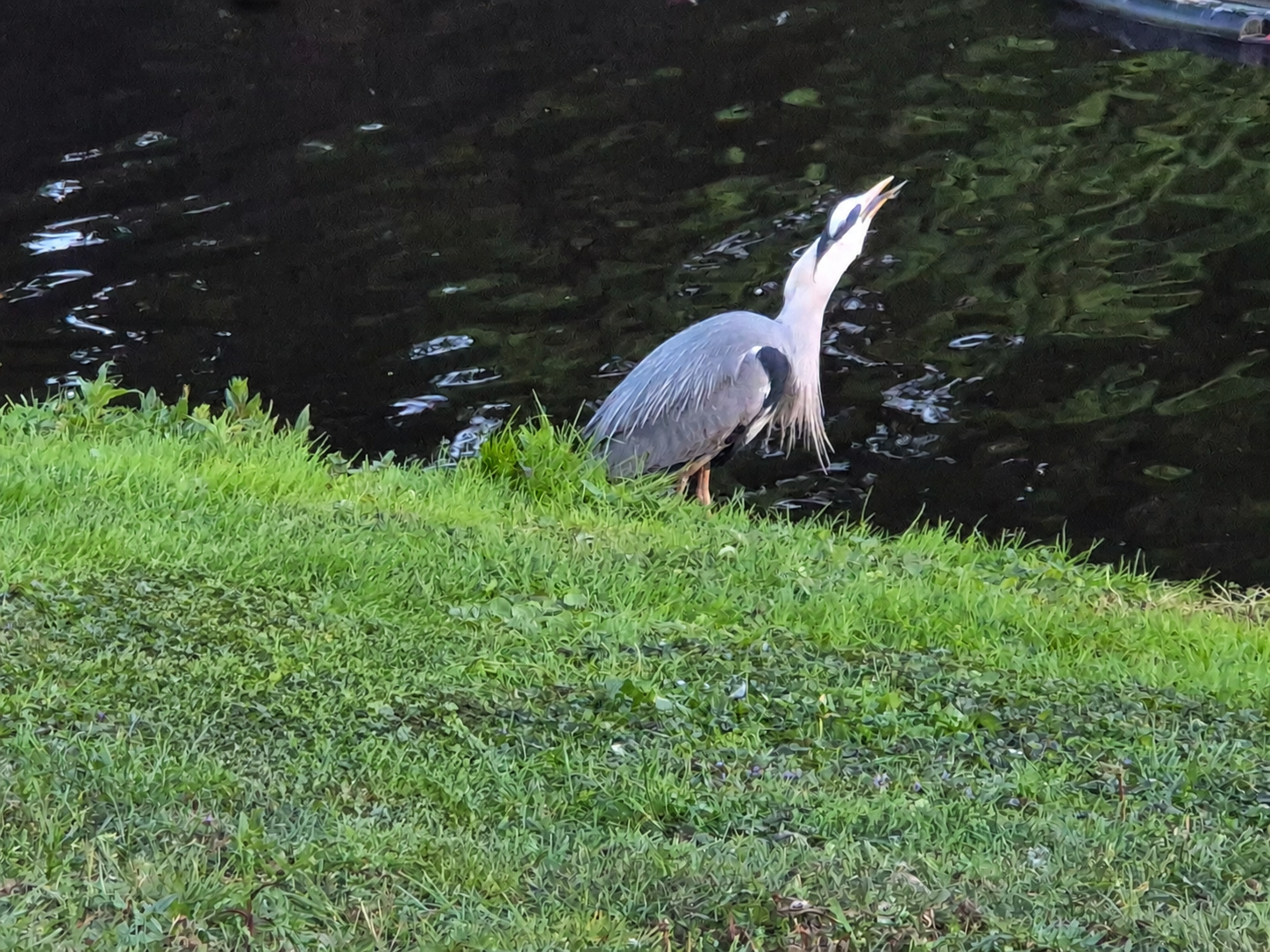
This train of thought started with a heron. He stood calmly by the side of a canal, proudly holding a fish this big (truly – it was about 30 cm long, and 8 cm wide in the middle) in his sharp beak. As I watched, he proceeded to stuff it down his throat – literally. He did not bite, and presumably did not taste a thing. His slender narrow throat swelled and you could see the fish going down his gullet.
It got me wondering: do birds taste their food? They sure as hell don’t seem to chew their food! Then do they eat purely for survival?
Compare that to what most of us are taught from childhood: eat slowly, chew your food, taste it! As we get older, we read mindfulness articles saying the same thing: savor every mouthful. Don’t gobble.
Modern humans don’t just eat to survive. Early humans did. But somewhere between the savannahs and the supermarket, food became comfort, reward, ritual, and a bad day’s, or even a good day’s, consolation prize.
What if taste was taken out of the equation? Would we still eat too much of a tasty thing? Would we use food to console ourselves when the emotions run high?
Here’s what I suspect: without taste, food would just be fuel. No comfort eating, no diabetes epidemic, no obesity.
I went on a fact finding mission. Online, of course. If LLMs say it, it must be true! Here’s what I found.
The heron isn’t tasteless – he’s just not a foodie
First surprise: herons do have taste buds – around 40–60 of them. Humans have roughly 10,000. So the question isn’t whether birds taste, but how. Their feeding mechanics are built for speed and capture, not sensory evaluation. The heron tastes after swallowing, not while deliberating. He isn’t tasteless – he’s just not a foodie.
Taste and flavour aren’t quite the same thing
This matters for the thought experiment. What most of us call “taste” is actually flavour – a composite of taste proper (the tongue’s five basic signals: sweet, sour, salty, bitter, umami), retronasal smell, and oral texture. Lose taste alone and you’d still have aroma, crunch, creaminess, temperature.
Taste is only one part of flavor, not the whole sensory drama of eating.
The sensory world of eating wouldn’t go blank. People with complete taste loss – a condition called ageusia – don’t necessarily become indifferent eaters. Some eat less. Some, frustratingly, eat more.
Side track – what’s umami? Sounds like a Japanese noodle!
Ha! It’s actually Japanese – “umami” (旨味) roughly translates as “pleasant savory taste.” It was identified as the fifth basic taste by Japanese chemist Kikunae Ikeda in 1908, which is why it kept its Japanese name rather than getting a clunky Latin one.
It’s the deep, savory, mouth-coating richness you get from things like parmesan, mushrooms, soy sauce, miso, anchovies, and slow-cooked meat. It’s why a good broth tastes “fuller” than water with salt in it. The molecule behind it is mostly glutamate – which is why MSG (monosodium glutamate) became such a widespread food additive, and why it’s not the villain it was made out to be in the 80s.
So yes – Japanese, not a noodle, but absolutely found in noodle broth.
The case for the hypothesis
There’s real evidence that palatability drives overconsumption. Calorie-dense, highly palatable foods activate reward pathways, disrupt appetite regulation, and make overeating easier. The emotional eating literature also gives the hypothesis some traction: comfort eating is real, it does tend toward hyperpalatable foods, and eating in response to negative emotions has been linked to increases in BMI over time. So yes – taste is doing genuine work in the overeating story. If you stripped it out, some of the pleasure-driven excess would probably go with it.
The case against
The COVID-19 pandemic gave us a large and unplanned natural experiment. Millions of people temporarily lost taste and smell, and researchers followed what happened to their eating. The results were all over the place. Some people lost weight because food felt pointless. Others gained weight, because eating became unsatisfying and they kept going, trying to hit a reward that wasn’t arriving. Some compensated by seeking saltier, spicier, or more textured food. A few increased alcohol intake, because flavours they normally found unpleasant were now muted. Remove taste, and eating doesn’t simply stop – it reorganises.
The emotional eating picture is also messier than the popular version. Research suggests that negative emotions often decrease intake in the average person, and increase it mainly in specific groups – high emotional eaters, restrained eaters. “We eat our feelings” is real for some people, in some moods, with some foods. It’s not a universal law.
Three things taste doesn’t control
Even granting that some hedonic overeating would decline without taste, three findings make the strong hypothesis hard to sustain.
First, your gut also tastes. Enteroendocrine cells lining the gastrointestinal tract carry taste receptors – sweet, bitter, umami – and they trigger hormone release (GLP-1, CCK, insulin) in response to what arrives. No conscious taste experience, but the body still registers that sugar landed. A person with no tongue-based taste would still receive post-ingestive reward signals from calorie-dense food. The hit doesn’t only come from the mouth.
Second, wanting and liking are different brain circuits. Neuroscientist Kent Berridge showed that the drive to pursue food (wanting, dopamine-driven) and the pleasure of eating it (liking, opioid-driven) are separable. You can have compulsive wanting with very little liking – some obese individuals show exactly this pattern: high drive to eat, muted pleasure from it. That means overeating doesn’t depend on taste pleasure to sustain itself. The wanting can outlast the enjoyment.
Third, the food industry doesn’t rely on taste alone. Ultra-processed foods are engineered for reward across multiple channels simultaneously – texture (the crunch of a crisp is somatosensory, not taste), colour, smell, portion size, familiarity, convenience. Removing taste would weaken one lever, not dismantle the machine. Back to the heron, thankfully at least he is completely unaffected by the food industry’s machinations.
So would diabetes disappear?
Type 1 certainly wouldn’t – its cause has nothing to do with food preferences. Type 2 wouldn’t either, because its drivers include physical inactivity, genetics, and a food environment that engineers overconsumption through far more than taste. Obesity itself is shaped by energy intake, activity levels, psychosocial factors, and the sheer availability of cheap, calorie-dense food. A tasteless world could still produce all of those.
The verdict
The strong hypothesis that food becomes pure fuel, lifestyle disease fades – doesn’t hold up to the evidence. The weaker version does: strip out taste, and humans would probably eat a little less for pleasure. But not less for all the other reasons humans eat – habit, hunger, social eating, boredom, the engineered texture of a crisp, the post-eating dopamine hit from five hundred calories of nothing in particular.
Taste is one strand of a much larger reward cable. Pull it out, and the cable frays. It doesn’t cut.
References and further reading
Side Interest
Lifestyle
- Obesity and overweight
- The role of emotion in eating behavior and decisions
- Variety, palatability, and obesity
- Emotional Eating, Obesity, Depression, Stress, and Dietary Patterns: A Review
- Emotional Eating Is Not What You Think It Is and Emotional Eating Scales Do Not Measure What You Think They Measure
- Relationship between Emotional Eating, Consumption of Hyperpalatable Energy-Dense Foods, and Indicators of Nutritional Status